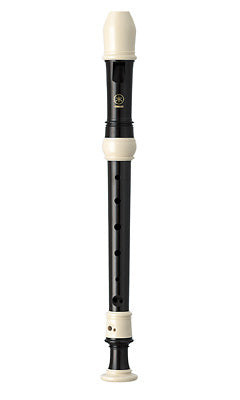
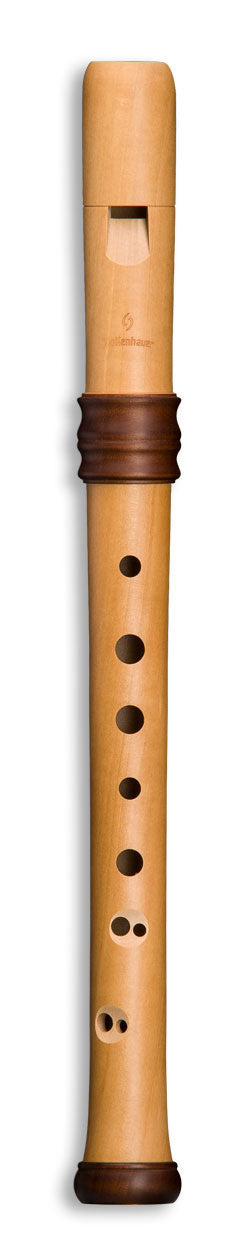
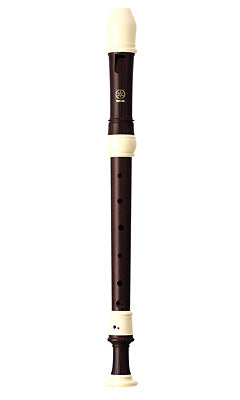
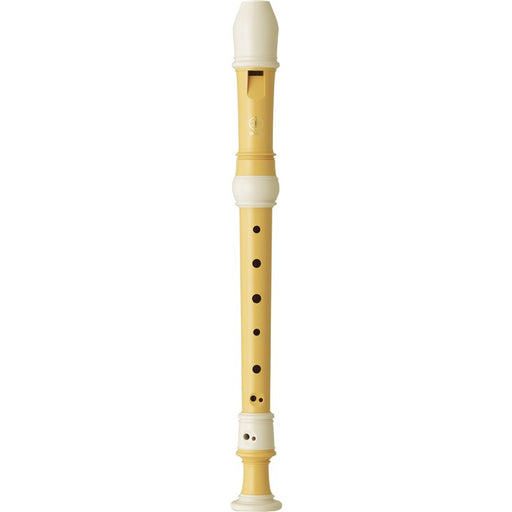
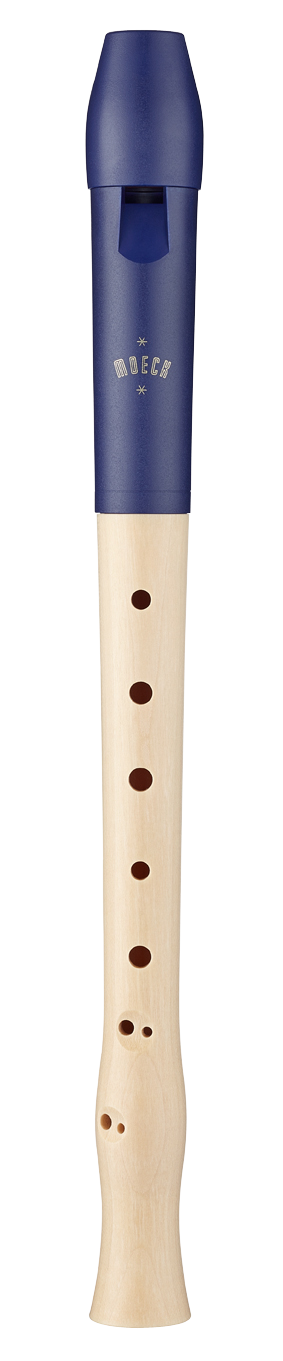
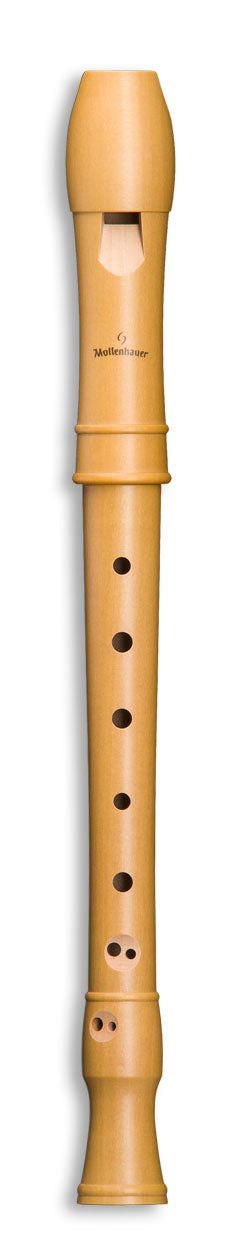
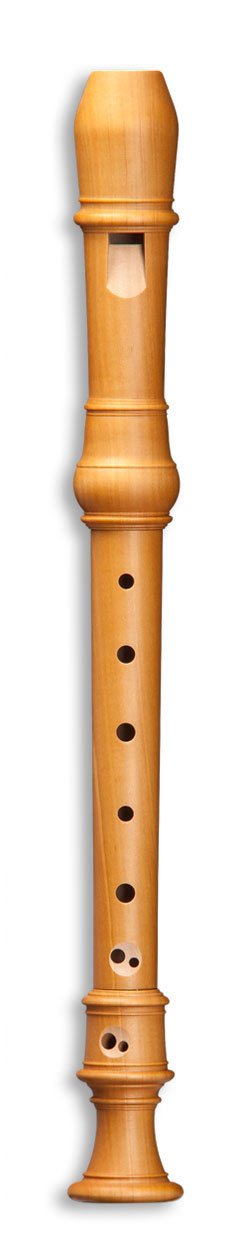
Soprano or Descant recorders are the best known of the recorder family and are often used as first instruments in schools. We stock soprano recorders from inexpensive plastic recorders to professional, hand-made recorders. You can browse through the selection and narrow your search with relevant filters or contact one of our specialists for expert advice.
Takeyama Soprano Recorder in Maple a=415. Takeyama from Japan is regarded as one of the foremost recorder makers. His a=415 maple soprano is extremely light to hold and characterised by a powerful, warm, flute-like sound, with great clarity in the upper register. With case, fingering chart, cork grease and pull through.
The 5212 Steenbergen soprano recorder in pearwood by Moeck is based on an original by 18th century maker Jan Steenbergen. Its 'typically baroque' glowing and warm sound makes this recorder a very expressive solo instrument. T he intonation is excellent and the bright, warm tone of this model is particularly effective in the upper register making it highly suitable for performing the most demanding Baroque repertoire. The Steenbergen series was designed by Guido Klemisch after an original by the Dutch maker Jan Steenbergen (1675-1728) which is in the Frans Bruggen collection in Amsterdam. The recorders have a narrow windway which offers a good degree of resistance, facilitating greater dynamic and expressive variation. This recorder is pitched at baroque pitch (a=415Hz) and is made from pearwood - European, hard, of very even density and fine texture. Specific density approx 0.65. Soft fundamental tone. This recorder comes in a leather hard case with cleaning rod and cloth, cork grease, fingering chart, maintenance instructions and a maintenance kit. Baroque fingering Double holes 3-piece Made of pearwood Includes free maintenance set (oil, brushes, anti-condensant etc) Pitch: a´= 415Hz Includes case, cleaning rod, cork grease and fingering chart 3 year warranty
The 5214 Steenbergen soprano recorder in Indian boxwood by Moeck is based on an original by 18th century maker Jan Steenbergen. Its 'typically baroque' glowing and warm sound makes this recorder a very expressive solo instrument. T he intonation is excellent and the bright, warm tone of this model is particularly effective in the upper register making it highly suitable for performing the most demanding Baroque repertoire. The Steenbergen series was designed by Guido Klemisch after an original by the Dutch maker Jan Steenbergen (1675-1728) which is in the Frans Bruggen collection in Amsterdam. The recorders have a narrow windway which offers a good degree of resistance, facilitating greater dynamic and expressive variation. This recorder is pitched at baroque pitch (a=415Hz) and is made from boxwood - even grain and density. Specific density 0.80. Clean, round tone. This recorder comes in a leather hard case with cleaning rod and cloth, cork grease, fingering chart, maintenance instructions and a maintenance kit. Baroque fingering Double holes 3-piece Made of boxwood Includes free maintenance set (oil, brushes, anti-condensant etc) Pitch: a´= 415Hz Includes case, cleaning rod, cork grease and fingering chart 3 year warranty
Mollenhauer Denner Edition Soprano in grenadilla, a=415. This is a hand-crafted recorder after Jacob Denner (1681–1735). The bore shape is based on concepts that were developed in the Denner family workshop, in particular by Jacob Denner. The Denner family from Nuremberg were one of the most important and influential woodwind makers. Modern processes have made it possible to achieve a sound quality that was previously only a characteristic of low-pitch baroque instruments. Balanced and stable intonation across all the registers are the basis for the versatility of the refined sound. The characteristically direct voicing combines lightness and brilliance with focused airflow. An extensive amount of time is dedicated to crafting these exclusive instruments. Every instrument is voiced over a long period of time – periods of intense playing alternate with phases of fine tuning. In this way, Mollenhauer can closely monitor and adjust the development of every instrument. Specification of the Denner Edition recorder: Craftsman-made windway Heavily undercut finger holes Bushed thumbhole Rounded and polished beak Finish: historically stained, oiled and polished by hand. Threaded joints Case: Leather bag Click here to read Mollenhauer's brochure about their Denner Edition recorders. Listen to this recorder: Your browser does not support the audio element.
Takeyama soprano a=415 brazilian boxwood. Takeyama from Japan is regarded as one of the foremost recorder makers. His boxwood soprano is bright and expressive, with great clarity in the upper register. With bag, fingering chart, cork grease and pull through. Listen to this recorder! Sammartini Allegro: Your browser does not support the audio element. Van Eyck Nightingale: Your browser does not support the audio element. Scale: Your browser does not support the audio element.
Mollenhauer Denner Edition Soprano in stained satinwood, a=415. This is a hand-crafted recorder after Jacob Denner (1681–1735). The bore shape is based on concepts that were developed in the Denner family workshop, in particular by Jacob Denner. The Denner family from Nuremberg were one of the most important and influential woodwind makers. Modern processes have made it possible to achieve a sound quality that was previously only a characteristic of low-pitch baroque instruments. Balanced and stable intonation across all the registers are the basis for the versatility of the refined sound. The characteristically direct voicing combines lightness and brilliance with focused airflow. An extensive amount of time is dedicated to crafting these exclusive instruments. Every instrument is voiced over a long period of time – periods of intense playing alternate with phases of fine tuning. In this way, Mollenhauer can closely monitor and adjust the development of every instrument. Specification of the Denner Edition recorder: Craftsman-made windway Heavily undercut finger holes Bushed thumbhole Rounded and polished beak Finish: historically stained, oiled and polished by hand. Threaded joints Case: Leather bag Click here to read Mollenhauer's brochure about their Denner Edition recorders.
Mollenhauer Denner Edition Soprano in satinwood, a=415. This is a hand-crafted recorder after Jacob Denner (1681–1735). The bore shape is based on concepts that were developed in the Denner family workshop, in particular by Jacob Denner. The Denner family from Nuremberg were one of the most important and influential woodwind makers. Modern processes have made it possible to achieve a sound quality that was previously only a characteristic of low-pitch baroque instruments. Balanced and stable intonation across all the registers are the basis for the versatility of the refined sound. The characteristically direct voicing combines lightness and brilliance with focused airflow. An extensive amount of time is dedicated to crafting these exclusive instruments. Every instrument is voiced over a long period of time – periods of intense playing alternate with phases of fine tuning. In this way, Mollenhauer can closely monitor and adjust the development of every instrument. Specification of the Denner Edition recorder: Craftsman-made windway Heavily undercut finger holes Bushed thumbhole Rounded and polished beak Finish: historically stained, oiled and polished by hand. Threaded joints Case: Leather bag Click here to read Mollenhauer's brochure about their Denner Edition recorders.
The 5218 Steenbergen soprano recorder in grenadilla by Moeck is based on an original by 18th century maker Jan Steenbergen. Its 'typically baroque' glowing and warm sound makes this recorder a very expressive solo instrument. T he intonation is excellent and the bright, warm tone of this model is particularly effective in the upper register making it highly suitable for performing the most demanding Baroque repertoire. The Steenbergen series was designed by Guido Klemisch after an original by the Dutch maker Jan Steenbergen (1675-1728) which is in the Frans Bruggen collection in Amsterdam. The recorders have a narrow windway which offers a good degree of resistance, facilitating greater dynamic and expressive variation. This recorder is pitched at baroque pitch (a=415Hz) and is made from grenadilla - even grain and density. Specific density 0.80. Clean, round tone. This recorder comes in a leather hard case with cleaning rod and cloth, cork grease, fingering chart, maintenance instructions and a maintenance kit. Baroque fingering Double holes 3-piece Made of grenadilla Includes free maintenance set (oil, brushes, anti-condensant etc) Pitch: a´= 415Hz Includes case, cleaning rod, cork grease and fingering chart 3 year warranty
A high quality solo recorder from the workshops of Dutch recorder maker Hans Coolsma (1919-1991). Their low-pitch sopranos are modelled after original sopranos by Englelbert Terton, a Dutch maker in the 18th century. This a=415 soprano is made of grenadilla and the thumbhole is bushed. This recorder comes with a hard case, pull through, fingering chart, maintenance instructions and a 5-year warranty. Baroque fingering Double holes 3-Piece Made of grenadilla Thumbhole bush Pitch: a´= 415Hz Includes hard case, pull through, cork grease and fingering chart 5 year warranty
A high quality solo recorder from the workshops of Dutch recorder maker Hans Coolsma (1919-1991). Their low-pitch sopranos are modelled after original sopranos by Englelbert Terton, a Dutch maker in the 18th century. This a=415 soprano is made of European boxwood and the thumbhole is bushed. This recorder comes with a hard case, pull through, fingering chart, maintenance instructions and a 5-year warranty. Baroque fingering Double holes 3-Piece Made of European boxwood Thumbhole bush Pitch: a= 415Hz Includes hard case, pull through, cork grease and fingering chart 5 year warranty
The "sixth flute", or soprano recorder in d, was a very popular instrument in eighteenth-century England, used extensively in concertos and solo works by various composers, such as Woodcock and Baston. This von Huene a=415 sixth flute follows an original which changed hands between Edgar Hunt and Frans Brüggen, and is made from turned boxwood.
A high quality solo recorder from the workshops of Dutch recorder maker Hans Coolsma (1919-1991). Their low-pitch sopranos are modelled after original sopranos by Englelbert Terton, a Dutch maker in the 18th century. This soprano is made of palisander and the thumbhole is bushed. This recorder comes with a hard case, pull through, fingering chart, maintenance instructions and a 5-year warranty. Baroque fingering Double holes 3-Piece Made of palisander Thumbhole bush Pitch: a´= 415 Hz Includes hard case, pull through, cork grease and fingering chart 5 year warranty
Stanesby Jr. Soprano Recorder (a440) in Grenadilla by Tom de Vries This soprano recorder has the round, full and open sound typical of a Stanesby Jr, being based on the Stanesby sixth flute from the Brüggen collection and scaled as a whole (including bore) to a440 pitch. The proportions of this recorder are very well balanced – almost ‘alto’ like – and the bore is relatively wider at the bottom than the Dutch instruments. This gives a very solid low register and versatile sound with a large dynamic range. A real concerto instrument, but also very suitable for chamber music because of its warm round sound – the perfect all-round recorder!
This handmade soprano recorder by German maker Martin Wenner is after an original by Engelbert Terton (1676-1752). It is made of European boxwood and pitched at baroque pitch (a=415). It has a clear, soft sound and is perfect for playing high baroque repertoire, including Sammartini's concerto. Terton was one the most famous Dutch recorder makers and had a worked in Amsterdam in the early 18th century. The original is extremely well-preserved and can be found in the collection of the The Hague’s Gemeentemuseum. It is made of stained boxwood and is beautifully decorated with engraved openwork silver rings. This recorder comes with a decorative handmade, soft case and Wenner's recorder oil.
This Terton soprano recorder follows an early eighteenth-century original in The Hague. It has long been respected by professionals and serious amateurs who need an a=415 soprano with brilliance and clarity in all registers. Very few original Terton instruments remain: a few alto recorders, one transverse flute, an oboe, and this superb soprano, made famous by Frans Brueggen's recordings. This recorder is made of boxwood in two pieces, like the original. It can be made with or without the ornate decorative silver rings like those on the original instrument.
A high quality solo recorder from the workshops of Dutch recorder maker Hans Coolsma (1919-1991). Their low-pitch sopranos are modelled after original sopranos by Englelbert Terton, a Dutch maker in the 18th century. This soprano is made of grenadilla with decoration and the thumbhole is bushed. This recorder comes with a hard case, pull through, fingering chart, maintenance instructions and a 5-year warranty. Baroque fingering Double holes 3-Piece Made of grenadilla with decoration Thumbhole bush Pitch: a´= 415 Hz Includes hard case, pull through, cork grease and fingering chart 5 year warranty
A high quality solo recorder from the workshops of Dutch recorder maker Hans Coolsma (1919-1991). Their low-pitch sopranos are modelled after original sopranos by Englelbert Terton, a Dutch maker in the 18th century. This soprano is made of European boxwood, has decorative rings and the thumbhole is bushed. This recorder comes with a hard case, pull through, fingering chart, maintenance instructions and a 5-year warranty. Baroque fingering Double holes 3-Piece Made of European boxwood with decoration Thumbhole bush Pitch: a´= 415 Hz Includes hard case, pull through, cork grease and fingering chart 5 year warranty