
Contact Us
hello@earlymusicshop.com
hello@earlymusicshop.com


You can find out more about the album and discover our review by clicking here, and of course you can purchase the CD online or in-store from our Snape Maltings shop.
Tabea took the time to chat to us about the new project and gave us some interesting insights into the creation of ‘folio’. Keep reading to the bottom of this blog to find out how you can WIN a signed copy of the album!

Find out more about why The Early Music Shop loves 'folio' by Tabea Debus & Tom Foster – click here!
Tabea Debus: folio has been bubbling away in my mind for quite some time, and I am thrilled to have been able to finally bring the programme to life with the amazing Tom Foster on harpsichord (and chamber organ). Throughout my musical life so far I've found myself returning to the music of JS Bach over and over - often in the form of arrangements, and usually with a different line-up of other instruments. So as part of this programme, folio, I've taken my love of this music as the starting point for an imagined 'portfolio' of lessons from the master himself (AKA JS Bach). It is definitely inspired by my own journey of studying Bach's music as well, and my own teaching and supporting others in their learning.
TD: For this (port)folio I was looking for a balance of works by Bach himself (which all have a link to him teaching his own students in some form or other), as well as composers who studied with him, or have been led or inspired by his music centuries later. The Albinoni Sonata, for instance, is an example of Bach using another composer’s work for his own lessons: in a manuscript copy of this violin Sonata (op. 6 no. 6 by Tomaso Albinoni) we can see the student's written-out figured bass part, alongside Bach's own corrections (and especially additions!), written with a different pen.
TD: As I'm often playing my own arrangements (or transpositions), one of the key decisions is which sound colour I'm looking for, and which recorder will work best for a certain key (i.e. which fingerings are comfortable, or produce interesting timbres). Of course, the style of the repertoire plays into it as well, for instance when choosing a certain type of recorder (e.g. a Denner model) for a certain type of music (e.g. German baroque). But in recording sessions my main criteria for choosing recorders are intonation, flexibility in sound, and 'stamina' (not blocking up too quickly).
I always bring an electric heating blanket to keep them sounding good, and make sure to let them air dry properly between sessions.
TD: Tom and I have played together in various instrumental constellations, and we have recorded an album together before (Favourites, also released on TYXart in Germany). He's a fabulous player and it is always a joy to play with him - and take inspiration from his phrasing, and ornamentation. It's like playing a game of tennis together, or perhaps a team sport.
TD: I love working with composers and adding to our repertoire is vital to keep it alive and buzzing - plus I feel I can grow as a player everytime I learn a contemporary piece, and collaborate with the composer. In the case of Alex Nante I was super lucky; I had asked him previously if he might be up for writing something for recorder and accordion, at which point he had too many other commissions to work on. But he did reach out to me again a while later to say that actually, he would like to write a recorder piece, as he had never composed for the instrument before. This is how Luz de otoño started. To this day, Alex and I have only met on Zoom, as he's mainly based in Argentina!
TD: The NCEM was a real luxury venue for us to record in! It's set up perfectly for early music recordings, with instruments and even people to tune them, and - most importantly of all - a lovely acoustic for a small chamber group or duo like ours. It is also in a mostly very quiet neighbourhood, which is perhaps even more important than a naturally good acoustic...
TD: I'm actually in the process of recording the next album already... :) I'm in Edinburgh with Samuele Telari (accordion) as I'm answering these questions, preparing for a recording with Delphian Records, to be released at the end of the year. It's called Would you keep a secret? and features a mix of old and new: from Dowland, Mozart and Schubert to two new pieces written for us by Sylvia Lim and Simone Cardini. And then there is also the long-awaited new album of my recorder quartet, Palisander: Double, Double, Toil and Trouble, to be released this year as well!
We are grateful to Tabea Debus for generously donating a signed CD to Recorder31 – to be in with a chance of winning the CD, simply comment your answer to the following question on this blog page, or on our social media:
Entries will be open for one week and we'll draw a winner at random from all correct answers submitted by Saturday 9 August at 12:00 BST. Good luck!
Described by The Times as a 'charismatic virtuoso', Tabea Debus is constantly exploring the horizons of music for recorder and has performed widely across Europe, Asia, North and South America.
As a soloist and chamber musician Tabea regularly appears with La Serenissima and The English Concert, and joined the recorder quartet Palisander in 2023. She has performed at the Wigmore Hall, in Early Music Series in London, York and San Francisco, the Festspiele Mecklenburg-Vorpommern, Musica Antiqua Bolzano, Edinburgh International Festival, and many more. She is a regular guest on the BBC Radio 3’s In Tune and Early Music Show, and has released seven solo discs to date.
---------------

Another instrument featured in our Sopranos & Smaller collection is the Moeck Flauto Rondo sopranino in maple. This entry-level wooden sopranino has a balanced tone with impressive projection for a maple instrument – a strong contender for players looking to progress to their first wooden sopranino. Check out the audio clips below or follow this link to find out more about this instrument.
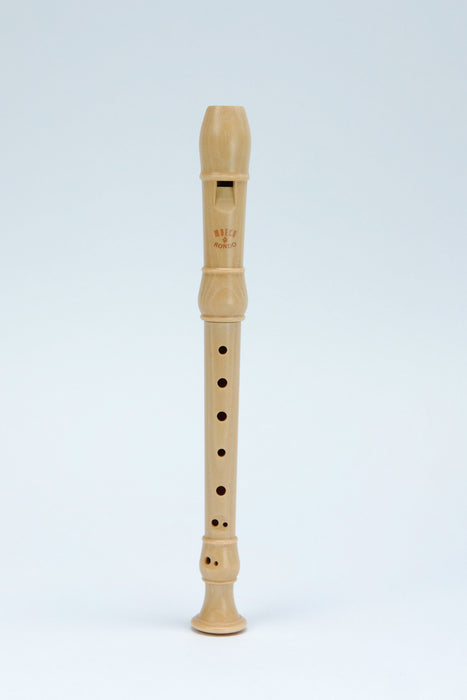
Listen to this recorder!
Handel Hush Ye Pretty Warbling Quire:
Playford Maiden Lane:
Scale:
Comments
Leave a comment